
By definition, copywriting is about writing with purpose. It’s not about delivering words on the page, but delivering outcomes like more business, more conversions and better customer retention. That’s why, in 2026, even the big players in AI are hungry for copywriters and so-called brand storytellers.
The problem? Finding and hiring the right freelance copywriter can be an absolute nightmare.
Clients are under pressure to prove the value of their investment in copy, especially when an uninformed CEO might think whatever the AI spat out is good enough.
That means finding someone to go beyond the words on the page. Someone who can think strategically, give you the benefit of their experience and creative taste, and deliver work with impact. All while making the experience feel not just easy, but easier than it would be to wrangle with an LLM until you get something you’re 75% happy with.
To help you build a business case for hiring a professional – and make sure you’re hiring the right one – here’s how I’d handle my search for the perfect copywriter, with some extra ideas from smart, immensely hireable copywriters in my network.
Table of contents
- Step 1: Understand what you’re paying for
- Step 2: Work out your basic copywriting brief
- Step 3: How to set a budget for freelance copywriting
- Step 4: How to build a list of potential copywriters
- Step 5: Make contact with your potential copywriters
- Step 6: Meet your new favourite freelance copywriter
- In conclusion: Find a good human who happens to be a great copywriter
Step 1: Understand what you’re paying for
Before you start hunting for the right freelance copywriter, you need to get clear on what you’re really paying for.
When I was starting out in copywriting, I didn’t know what I was doing. And when I met the first client who came with a four-figure budget, I panicked hard.
It’s too much for a handful of web pages. If I quote for the entire budget, I’ll be overcharging them and, in turn, I’ll start sinking under the pressure of expectations. No, I’ll send them an estimate in-line with what I’m charging everyone else, budget be damned.
Of course, they went elsewhere. Because they were budgeting for outcomes, and I was still invoicing for words. They understood the value they were willing to pay for, while I didn’t understand the value of what I was doing every day.
If you’re just trying to fill space, you should probably stop reading here before you waste any more of your time and money.
“When it comes to hiring a freelance copywriter, clients who are focused solely on cost have lost sight of the value we can provide. Good copy will help them improve their marketing and increase sales. That’s why their focus should not be on what the copy will cost them, but on what the copy could do for them.”
Steven Stark, Freelance Senior Copywriter
What does a freelance copywriter do?
A freelance copywriter is someone who writes words for advertisements, for more than one client. Thanks, Cambridge. But that’s what it means, not what we do.
Here’s what my average week looks like.
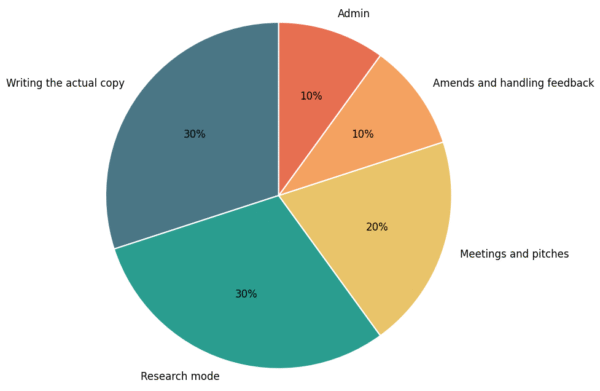
That’s just a third of my time on writing. So: what does a copywriter do? Most of the time, it’s not writing the copy. It’s doing everything else that will inform whether the copy works or not.
Anybody who has dabbled with the idea of being a copywriter can probably write words that make sense. But you could probably do that yourself, at a push.
What a copywriter really brings to the party is an ability to pinpoint what’s important from huge amounts of background material and context, including:
- The competitive landscape
- What genuinely, authentically makes your business different
- What your customers think and feel
- Your audience, how it’s evolving, and what they care about
- Where you’ve been and your strategy for what comes next
Using that information, they’ll:
- Find creative ways to make copy capture attention and convince people with compelling ideas
- Use empathy and intuition to understand what readers might be feeling at any given moment, then write copy that addresses those needs or concerns
- Own the copy aspect of a brand or project, safeguarding consistency and understanding how different assets connect into a customer journey
- Bring a level of experience and expertise in how the most effective copywriting works, so you can feel confident about what you’re putting out there
As I put it to a client a few weeks ago: ‘Anyone can write, but you’re really paying a copywriter to think.’
On his website, word nerd Matt Phil Carver has a great list of the non-writing things a copywriter does:
“Being good at writing isn’t particularly valuable as a skill. There are many, many people who can do it. AI can do it. (Sort of. Debatably.). When I look at how I’m described by clients, the recurring themes aren’t about writing at all.”
Matt Phil Carver, Brand Writer
In summary: Before you find a freelance copywriter, it’s a good idea to get clear on the value you expect them to deliver. If it’s nothing more than generating words and filling space, you’re probably wasting your money.
Step 2: Work out your basic copywriting brief
Briefing a copywriter is all about understanding the deliverables you want them to create and what the impact of those deliverables should be. It might sound simple, but my experience tells me that not every client knows that.
That’s why, before you even think about shortlisting potential writers, I recommend taking a step back and really interrogating what it is that you’re trying to buy.
There are plenty of briefing templates online, but it only really takes a sentence at first: we need a freelance copywriter to write <deliverables> that:
- … help us reach a different kind of customer.
- …convert traffic into leads.
- …perform better in search engine results.
- …make us look more professional/trustworthy/fun/any other adjective.
- …are a better reflection of our brand today.
- …give us more personality.
- …support a new strategy we’re trying.
- …are more engaging and emotive.
These are just a few ideas to get you started. What matters here is giving your copy a sense of purpose from the outset. A writer communicates with people through words. A copywriter compels people to take action, whether that’s clicking a button, making a phone call, or just seeing your brand in a new light.
How detailed does a copywriting brief need to be?
It used to be common for clients to prepare a 1 to 2-page creative brief, including some basic information on the brand, deliverables, timescale, budget, audience, and desired outcomes.
These days, I don’t see these more formal briefs very often outside of structured procurement processes with RFPs. And when I do, they’re often clearly generated by AI, which isn’t great for relevance or usefulness.
“The worst briefs I get are AI-generated. They’re incredibly generic and the outlines don’t have an engaging flow to them. They read like a checklist – and a really boring one at that. They’re flat and unhelpful to me as a writer, because I know that the reader won’t benefit from some of the topics suggested and they’ll be bored before they get to the part that’s actually helpful.”
Kerri Holtzman, B2B Freelance Copywriter & Content Writer
I’m with Kerri. Whether they’re written by human beings or LLMs, a needlessly exhaustive brief feels prescriptive and makes it harder for a copywriter to use their expertise, shaping the structure, messaging, and approach. Worse, even the most in-depth copywriting briefs are rarely sufficient.
A good copywriter will go on their own journey to research your business, brand, competitors and audiences – and probably have their own process. When you use a freelance copywriter, part of what you’re paying for is the fact they’ve done this hundreds, even thousands of times. So there’s no need to do all the work yourself. Instead, let the copywriter lead you.
While you might feel some pressure to write down everything you know in one huge document, less is generally more at this early stage. Your copywriter will know how to get the information they need. And, in an ideal world, we want to move from emails, quick calls and written briefs to an actual relationship as soon as possible anyway.
Making your copywriting brief bigger
If you’re not sure exactly which deliverables you need, that’s okay. A seasoned freelance writer has probably picked their way through multiple agencies and a whole bucket full of end-clients. And a curious, invested copywriter will always be paying attention to what works and what doesn’t.
The deliverables are useful if you’re looking to get a quick cost or move fast, but they’re not that important overall. Most copywriters can turn their hand to any touchpoint, on any channel, and will be happy to help you figure out what’s best.
What’s essential is that sense of purpose. When you know what you need to achieve, a good copywriter will be able to put a strategist hat on to help you figure out how to make it happen.
In summary: Plan your brief early but keep it light. You only need to know the sort of work you need and what you hope to achieve. When you build this sense of purpose into your workflow early, you start safeguarding the outcomes that matter.
Step 3: How to set a budget for freelance copywriting
To set a budget, you need to think more about the value of the outcomes you’re after than what feels like the ‘right price’ for a given deliverable.
Take a SaaS brand as an example. We don’t want someone to write some landing pages and PPC ads. We want someone to write a small customer journey that generates traffic and drives conversions. And if we know the average subscription revenue from a new conversion, we can start to feel out a broad budget for the copy we need.
What makes it harder is the fact that not all copy ties to a direct metric like conversion rates. Sometimes it’s about getting your brand out there or helping existing customers see you in a new light. In these instances, you’ll need to come at the problem from the other direction: what are high/medium/low rates for the sort of copywriter you need? What will the right expertise cost you?
Often, the fastest way to get an answer is just emailing a handful of freelance copywriters for an early indication. There’s no need to go through the whole spiel – just say ‘We’re thinking of doing some work on our X, can you give me some ballparks that I won’t hold you to?’
Whether you ask for early estimates or build out your budget based on value, here are a few things to keep in mind:
- Avoid per-word, per-day and per-hour rates: they set the wrong incentives (to write extra words and go very slowly)
- Build space into your budget for meetings and calls: the last thing you need is someone who nickle and dimes you for every little interaction
- If you can, budget for some QA time from the copywriter: this is things like updating your style guide to reflect key decisions, or checking copy once it’s in its final, designed form (not enough people do this!)
- Expect to pay a 50% deposit upfront: this is fairly standard
What’s the average rate for a freelance copywriter?
The 2025 ProCopywriters Survey puts the average day rate at £480 in the UK (not that it’s a great idea to start paying for work by the day).
What’s telling, though, is the steady increase in rates since 2020. With increased pressure from AI and junior copywriters trying to ‘level up’ because LLMs removed the content-driven bottom of the market, I would expect rates to continue to grow over time.
In my anecdotal experience, the most experienced copywriters are trying to move to fewer more lucrative projects rather than a run-rate of smaller bits and pieces. So while there’ll be fewer of us, the ones who are still here will charge more.
Truth told, I couldn’t even tell you what an average copywriting rate is – and I’ve been doing this for over a decade.
A cursory search of UK copywriters gives me some average copywriting rates that seem to make sense. Keep in mind these will vary if you need a specialist, over in the world of direct response, and internationally.
| Project | Price range |
| Website copy | £200-£350/page (assuming a ‘normal’ length up to 600 words) – expect to pay more for very long pages and high-pressure spots like the homepage |
| Emails | £150-£200/item (with a lot of variety depending on the nature of the email; a long-form lead gen piece is more expensive than your short monthly newsletter) |
| White papers, brochures and longer guides | £200/page is a good rule of thumb (but you may need to pay for interviews and research on top) |
| Video and animation scripts/voice over | £140-£180/minute |
| Blogs and articles | £300-£400 for an 800 to 1000-word length and associated research |
| Messaging, positioning and tone of voice projects | £1k to £1.5k for writing good guidelines – 2x-3x that to actually lead the process and help define what the positioning and tone of voice should be |
But that doesn’t mean someone’s in the wrong if they charge you double, half, or any amount in between. Remember, you’re not just paying for the work – you’re paying for the right person. And you can trust that, whatever they set their rates to, that’s the correct rate for them (even if you decide you don’t want to pay it, or think you’re getting a bargain).
“Your budget depends on what’s important to you. If budget is your concern, pay less for an inexperienced writer. You’re likely to be able to train them to give you what you want, with the trade off being more rounds of reviews and edits. But if you want the job done right, by someone who understands how to take direction and can anticipate things you need – and can afford to pay more – you usually should.”
Joe Shearer, Content Marketing Professional
Why don’t freelance copywriters share their rates?
Most freelance copywriters don’t share their rates online, although, in the past few years, I’ve seen more people move to a commoditised, packaged approach where you buy a bundle of deliverables, or even pay a monthly subscription.
In part, that reluctance to share rates is just good salesmanship (the same salesmanship you’re hoping they’ll use in your copy). A freelance copywriter wants to build rapport and a relationship with you, highlight their relevant experience, position themselves as an expert, then hit you with the money. But it’s also because every figure comes with a caveat.
Your new website might estimate out at £300 per page. But if you seem easy to work with, like the amends will be manageable, and like you’re going to be helpful in preparing relevant source material, that could tend down towards £200. If you’re a huge brand with dozens of stakeholders who’ll need to sign off on the copy, you could probably expect the copywriter to build in some extra breathing room and danger money.
In this sense, it’s important to know what you have to offer the copywriter, not just in terms of your budget, but the project itself.
“There are two types of projects: one for the meal and one for the reel. Both get your best effort, but they’re different efforts. Working ‘for the meal,’ you’re paid to be efficient, smart, professional. Getting to solid ideas and finishing them off quickly. Working ‘for the reel,’ the work gets extra juice, extra creative top spin. The pay is beyond dollars. It helps you build your portfolio and flex what’s unique about you as a writer.”
Al Wyatt, Founder/Director, Jetpack Agency
Al, whose name I now realise looks exactly like AI written down, is spot on. Be frank with yourself about the project you have on the table. The money, time and effort conversation is very different if you’re a household name doing a big, layered, potentially award-winning outdoor campaign versus a startup looking for a single blog post. Harsh but true. If your project is especially small, it might be worth bundling multiple projects together at once, so the total fee makes it worth the inevitable onboarding and initial research that comes with any new client.
Equally, not enough clients share their budgets. Common sense negotiation says you should let the other person take the lead but, if you find a copywriter who seems like a basically normal person – the kind of character you’ll want to work with – there’s nothing wrong with telling them what you have to spend and finding out what you can get. You might find it’s more than you had expected.
When you share your budget, you can also lean on your potential copywriter’s knowledge. If I know you’re trying to make your website convert and you have £2k to spend, I can tell you where you’ll get the most bang for your buck. Tell me what you need and what you have, then I’ll tell you what I can do.
As someone who takes transparency and directness pretty seriously, I’d love every client to state a problem, name a budget, and let me tell them what’s possible. But I recognise not every freelancer has the same approach. Some might see your budget as a target to hit, not a limit to work within. So, if I was searching for someone, I can see why I might want to keep my budget to myself, at least at first.
In summary: From experience, I can tell you there’s nothing worse than running a project with a copywriter who feels undervalued and underpaid. They stop going above and beyond to share what they know – and, while you probably get your money’s worth, you don’t get anything more than the words on the page.
So ask copywriters what they charge, negotiate where relevant, but always be prepared to politely walk away if it doesn’t make sense. It’s not personal, because you both want the same thing: someone who’s good at what they do, being fairly compensated, and delivering value to match.
Step 4: How to build a list of potential copywriters
Here’s the thing: the very best way to find a freelance copywriter is to ask someone else for a personal referral.
Yes, it’s a way to get an outside seal of approval and hear first-hand about the experience of working with the copywriter. But it’s also a great way to make your week easier, because you don’t really have to think about the choice.
If you can do that, do that.
If not, here are some things to consider as you start to scour the internet and build a list of people to contact.
What should I look for in a copywriter?
Freelance copywriter Lauren Holden put together a useful list of some common criteria that might (or might not) be relevant to your search:
- Someone who’s local to you and available for in-person meetings
- Someone who ‘just gets’ your business, tone of voice, and the way you work
- Someone who isn’t afraid to take the reins if needed and tell you what’s working (or what isn’t)
- Someone who can adapt to your budget, wants and needs
- Someone who takes your feedback on board and is happy to work around you
- Someone who can fit your work in within a reasonable timeframe
These criteria might influence where you go to start building your list. If finding someone to work around your strict existing process is important, it might be that job boards are a good place to start. If you’re on a tight timeline and need someone who’s instantly available, you might start on social media to see whether anyone seems to have gaps right now.
Decide what it is you’re really looking for – that’ll almost certainly help you know where to find it.
“The copywriter for you depends on the factors that are important to you. You need to find someone who’s attuned to how you work.”
Lauren Holden, Freelance Copywriter
Does your copywriter’s location matter?
In late 2025, I saw an uptick in search queries for ‘UK copywriter’ and ‘UK freelance copywriter.’ This would suggest that, to some people, location is still an important criteria in finding the right person for the job.
I can only assume this is about those little linguistic differences in English around the world. If you’re based in the UK and writing for a UK audience, a native might give you some extra peace of mind. There’s also the potential for a better timezone match or an in-person meeting (although these seem to happen a vanishingly small amount now).
I’d caution against limiting your search too much by location.
In the past year, I’ve worked with clients in the UK, but also in France, the United States and the UAE. They all have their own preferences, culturally and linguistically (weirdly, France seems to love writing in basically-UK-English-but-also-using-the-letter-Z-a-lot). Switching back and forth is as simple as flicking a switch, mentally and physically in the document itself.
In many ways, it’s no different than the way you’d expect your copywriter to effortlessly adapt depending on the current project. Writing for your website is different to writing for your employee newsletter, which is different to writing a pitch deck. And writing for you is – should be – different to writing for every other client.
What are the best places to hire freelance copywriters?
Some obvious routes are job boards, copywriter directories and recruitment websites, but clients often find themselves on freelance marketplace websites like Freelancer.com and Upwork. That’s what happens when those sites have a stranglehold on search results and huge budgets for ads.
The default senior copywriter position is, no, these sites are all terrible. But it’s a little more nuanced than that.
Fifteen years ago, I started my career on marketplace websites. I had no experience, no formal training aside from my English degree, and no idea where to start. So People Per Hour was an obvious choice and, you know what? It worked. At first. Not for long.
In those early days, my focus was this: I’m not very good, so what I can do is work harder and faster than everyone else. That’s exactly the mentality you need for a marketplace website, and it served me well.
It can work for clients, too, because:
- You only need to look in one place – it’s faster
- You manage the whole relationship within the platform
- You have some accountability if the work is crap
- The nature of bidding on marketplaces inevitably pushes prices down
But, as you might expect, there’s a huge catch. These marketplace websites take a cut for their platform, usually between 5% and 20%. Why would any freelancer in their right mind be giving a platform 20% if they were good enough to get work elsewhere? Especially when that’s 20% of a fee that was already driven down by the biases built into the platform itself?
You’re looking for a copywriter. If they’re not capable enough to market themselves without help from a ready-to-use marketplace, why would they be able to do anything differently for you?
There’s also an AI consideration. Being forced to work for an alarmingly low rate is going to tempt your copywriter to use AI with abandon – or possibly even necessitate it just to stay afloat. And, if you’re just looking for words to fill a space, you could probably use the AI yourself and cut out the middleman.
Instead, you need to find the right person in a place where they’re showcasing themselves, putting everything they claim to know into practice. That’ll usually be their own website or portfolio; it might be their social media presence.
Time to hit the search engines.
“A good copywriter should exude their expertise and capability in every piece of communication they exhibit. Emails, calls, portfolios, websites, socials. If a client looks at anything like that, they should get an instant idea of whether or not this person is the right fit.”
Georgie Steele, Freelance Copywriter
How do I find a specialised copywriter in my niche?
The great thing about specialist, niche freelance copywriters is that they’re incredibly easy to search for – plug ‘freelance copywriter’ and your vertical into your favourite search engine and you’re away.
But it’s important to consider whether you really need a specialist at all, or whether that might limit the perspective and experience you have access to. This could also have an impact on cost and availability: the best specialists I know are hyper-sensitive about potential conflicts of interest when your brand is too similar to an existing client, and always charge a premium when they’re working in their niche.

I’ve always been a generalist freelance copywriter, but I’ve built up some experience in specific areas like SaaS, consulting, health, and tech. Creatively, this is sometimes more of a limitation than an opportunity. The truth is that it’s harder to come up with something fresh when you’re the fifth health and wellness client I’ve worked with this year.
Conversely, the experience from seemingly disparate projects can be a real benefit. At the end of the day, we’re writing for people – and an approach that connects with people in one industry might be just as impactful in another.
Copywriter Joe Shearer puts it wonderfully:
“Writers are storytellers, and copywriters are telling someone else’s story, not their own. Having told someone else’s story that’s superficially similar to another really isn’t that helpful. Storytelling skills are universal, and getting to the heart of the story, and writing that story, is the key skill a copywriter needs. Other details quickly fall into place.”
Joe Shearer, Content Marketing Professional
The point is: you’re looking for someone with experience solving the kind of problems you need to be solved. For my imaginary SaaS brand, I’d be much more inclined to go with a copywriter who has a proven track record decrypting complex products and making them feel human than I would a less experienced freelancer who is a self-professed SaaS specialist.
“Experience matters and you get what you pay for. Even if the writer doesn’t have direct experience in your vertical, it doesn’t mean they can’t handle the assignment. Think quality over direct industry experience.”
Adam Kaplan, Creative Marketing Executive
What performance data should I look for?
Copywriting isn’t about making things sound pretty — it’s about getting results. It’s only natural, then, that you’d be looking for hard numbers about the impact of a copywriter’s previous work.
Freelance copywriters know this. That’s why we all continuously drop words like ‘conversion’ and ‘results’ and ‘clicks.’ But, if my very limited insight through a small sample size poll is anything to go by, most of us don’t have the actual numbers to give you.
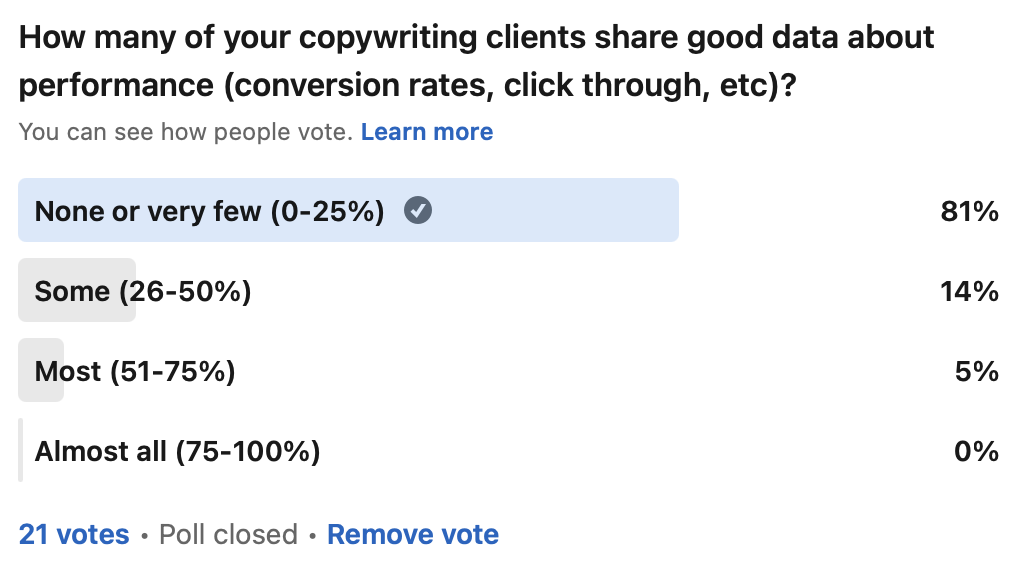
I asked 21 copywriters on LinkedIn whether their clients shared performance data with them. 81% said they got data from no clients at all, or very few. And absolutely nobody (0%!) said they got consistent data from almost all of their clients.
While the sample size is tiny, this included copywriters in multiple countries, at different levels of seniority and experience. And it definitely reflects my own experience over the past 15 years: I can count the clients who have been transparent with their data on one hand. According to copywriters over on Reddit, I’m far from alone.
That doesn’t mean you shouldn’t be looking for performance, or a copywriter that goes beyond writing words to actually make important stuff happen. It’s just that the real metrics you might use to measure that performance aren’t very direct.
Client retention is a good one. Some of my clients have been with me for over a decade and that surely indicates that the copy is doing what it needs to. Another is to ask about the longevity of some copy – if a PPC landing page is still online and doing its stuff after five years, it’s probably getting the conversions it needs.
If I was looking for a freelance copywriter, though, I’d probably focus my ‘results’ conversation more around adaptability. We all know the best practices for conversions, but what works for one client won’t work for the next. For real results, it’s way more important that your copywriter has a mentality of continual improvement and optimisation: get something out there that should perform, see if it actually does, and refine it over time until it delivers.
What should I look for in a freelance copywriter’s portfolio?
Portfolio evaluation isn’t easy, but try to keep the focus on what you’re looking for: someone with deep experience doing the type of work you need. Colourful mock-ups and creative campaigns are exciting, but they can also be distracting. Someone can be an incredible freelance copywriter and still be the wrong copywriter for you.
Here are the four biggest factors I’d be looking at in a portfolio/on a freelancer’s website:
1. Trust signals like testimonials and logos
A personal recommendation is best but, if not, an impersonal one will do. Check for work for familiar brands and well-known agencies, alongside testimonials and reviews from those clients that describe what the experience and the work were like.
“Look for a copywriter with client testimonials showing a proven track record of getting results.”
Bob Bly, Direct Response Copywriter
2. Specific capability plus useful versatility
Check that the copywriter has delivered the precise type of work you need. If you’re putting together a nurture email campaign, you’ll sure as hell want a writer who knows their way around email. And if they’ve done it a lot, that means more insight and perspective to bring to the table. They’ve already seen what works and what doesn’t. This is the insight you’re hoping to buy.
I’d be reluctant to run with a copywriter who specialises in a single type of asset, though. Today’s customer journeys are complex and varied. Campaigns cross multiple touchpoints and, for copy to be any good, it needs to consider the whole context. That means, even if your current project is about emails, you want someone who understands the related landing pages, PPC ads, and so on.
“I would ask whether or not the copywriter has done both short and long form projects. Versatility is a must for 360 campaigns to work.”
Paul Benenati, Copywriter
3. Going beyond the basics
At the most basic level, a copywriter will write copy that engages people, offers clarity, focuses on benefits instead of features, and compels people to take action. But these are hygiene factors: they’re to be expected.
While there’s a case for occasionally stating the obvious, I look for a sense that the copywriter is going beyond these basics – selling themselves and what makes them unique, rather than selling the idea of copywriting itself. That might be interesting clients, unique experience, or strong opinions about what makes their copywriting especially good.
“I’m not here to sell you on hiring a copywriter. What I can sell you on is what I do better than other writers, the profit my writing has generated, my timeliness, my formal training, and the years of experience I have in my niche.”
Matt Hall, PR & Content Manager
4. A sense of identity and personality
Use your gut: does this copywriter make you feel something? Do you get a sense of who they are, what they’re about, and what they’ll be like to work with?
If we assume a basic level of competence across all freelance copywriters, it’s the experience of working with them that sets them apart. That’s why I want portfolios and websites to put a stake in the ground by actually having a personality. It doesn’t have to be about random asides and telling you their favourite pizza topping. But, beyond a list of copywriting services, you should always be able to catch a vibe – and see if that vibe fits with yours.
“Don’t hire copywriters for their resume. Don’t expect their portfolio to be a perfect example of your niche. Copywriters aren’t defined by their employers, but their thinking. Hire the copywriter who’s willing to dream and push boundaries.”
Shon-Leuiss Harris, Copywriter, ACD & Content Strategist
In summary: You can find freelance copywriters on marketplace websites, but you’ll get a better breed of writer if you just head to a search engine (or, ideally, get a personal recommendation). From there, you’re looking for people who have done the type of work you need, for lots of different people, who also seem well-rounded and knowledgeable about copywriting in general.
Pass that through a common-sense personality filter – does this feel like someone I’d want to work with? – and you’ll arrive at a list of copywriters to get in touch with.
Step 5: Make contact with your potential copywriters
Once you have a list of freelance copywriters, it’s time to open up the doors of communication: make that call or send that email.
Keeping things simple, you’ll want to cover:
- Who you are: your role, your brand, and a link to your website for background
- What you need: the specific project, the deliverable, and any timeline you might have
- Relevant assets: you might be ready to share your brand guidelines, tone of voice, or a more extensive brief if you have one
Usually, these are enough for the copywriter to consider the project, think about availability, and get back to you with the next steps. And if you’re going to share your budget at all, now’s the time to do it. Better to find out that you can’t afford this specific copywriter now, rather than after you’ve wasted time going down the funnel.
At this stage, you’ve probably got a whole load of questions for your potential copywriter. Hold your fire.
In my experience, emailing back and forth doesn’t tell me an awful lot about a copywriter. Instead, aim to get into a real life human conversation as soon as possible – it’s as simple as closing your first email with a suggestion that you speak whenever it’s convenient.
“If you can, meet them in person, talk about their interests and anything but the work. Their personality will tell you bucket loads.”
Cormac McCann, Creative Director
It’s also a good idea to keep things small and focused for now. You might have a whole team involved in the project, but start with a single point of contact – that’s you. If not, you could set alarm bells ringing for a copywriter who’s trying to avoid a complex, confused way of working.
“Sometimes a company will have different departments throw in their opinions on the creative direction of a brand based on their personal experience in their own department. To feel confident that my work will be respected, I like to see a clients’ marketing team owning its marketing and creative process.”
Wayne Walker, Digital Copywriter
Should I ask a copywriter to do a free sample or test?
The short answer is no, but perhaps not for the reasons you might think.
Despite what most established freelancers would have you think, the concept of ‘free work’ isn’t entirely bad. If I’m putting in a proposal for a big project (think £4-£5k minimum, like a website), my standard template includes space for me to show a few examples. I might put together a 100-200 word chunk that shows how we can make the copy more focused on our key messages, or elevate the tone. This works for me, because it’s often easier to show you what I’ll do than spend four pages trying to explain it.
But that’s the crucial point: it works for me. And I’m the one that’s decided it’s worth the time investment.
It’s not that a freelance copywriter should never give you something for nothing. It’s that, when it’s your idea and you ask for it, you’re sending signals that potentially start the relationship off on the wrong foot.
When a new prospect says ‘We’ll need you to write an unpaid sample piece,’ I hear ‘We don’t see you as an expert and we don’t respect your time.’ What the prospect is really saying is ‘We don’t feel confident and we’re nervous about this process.’
So, why don’t we have that more honest conversation? Tell your potential copywriter that you’re scared about making this decision, that the people above you will berate you if you get it wrong, and that you need help to feel more confident. Explain the real problem and trust that an experienced freelancer knows the best way forward.
That could be:
- Sharing more targeted examples of previous work that’s super relevant, but not necessarily in the more general portfolio
- Getting on a call with your most challenging stakeholders to help them feel reassured
- Writing an example, for free, providing the freelancer decides what it is, how long it is, and whether to do it at all
In summary: Freelance copywriters love getting juicy new enquiries. But keep your first contact light and breezy – you’re trying to strike up a relationship and start a conversation, not inundate the writer with hours of reading and admin before they’ve even sure they’ll get the project.
Step 6: Meet your new favourite freelance copywriter (and some other great ones)
Speaking to your potential copywriter, one human to another, is the fastest way to know whether the relationship is going to work.
It’s where you’ll go beyond their ability to write to get a sense of who they actually are, what they care about, and how they work. It’s where you’ll see whether they’re sharp and quick-witted, or slow and potentially witless. And, believe me, if they can think on their feet, they can think before they write.
I would allow for up to 30 minutes with each of your potential copywriters. This is enough time to explain your project and ask/answer key questions. And, if you ask for more time with no real commitment, any busy copywriter will have to think about billing you. We don’t want that.
You’ll be tempted to go into exhaustive detail about your project, but that’s not the focus. By all means share the headlines: what you’ve been doing, what you’re now doing differently, and how the copywriter can help. But the real focus should be on getting the information you need to make a good decision.
“In my experience, most clients – direct clients, not marketing pros or ad agencies – have no idea what to ask a copywriter.”
Georg Turner, Copywriter
What questions should I ask a copywriter in an interview?
I’d hazard against calling it an interview. Few of us went freelance because we wanted to do normal recruitment stuff. But whatever shape it takes, whether it’s called a chat, or a discussion, or a consultation, you’re interviewing: you’re assessing whether the person you’ve met is right for the job.
In your initial discussion, you’ll ask about the copywriter’s relevant experience, their way of working, their approach to copywriting, and how they can help.
Some of their answers will tell you things you need to know. Others will help you gently test their ability to think strategically and creatively, the two most important skills you’re paying for.
Ask: How do you usually work?
This is a great place to start because of the subtle cue it sends to your potential copywriter: you’re a human, I respect that you have your own way of working, and I intend to honour that.
Ask any group of freelance copywriters and you’ll find that ‘being treated like an employee’ is a major problem. That’s why nobody wants to be always on call, or to join your Slack channel, or to promise availability that might not be there in a month.
“Always ask a potential freelance copywriter about how they prefer to work. Some of us have years of in-house or agency experience before going out on our own. Others have been solo since day one. If your team needs someone to fold into the company, that background matters.”
Shon-Leuiss Harris, Copywriter, ACD & Content Strategist
Ask: What’s your most relevant project?
Once you’ve explained your brand, your industry, and what you need, let the copywriter bring their most relevant work to the surface.
You can’t fully judge work based on its final form. You don’t know the challenges that were involved or how the copywriter solved them. So create space for the writer to talk you through it. You might find that the copywriter has a fantastic, relevant example where they solved the exact same problem you’re faced with, even if it’s in a different industry or a different type of asset.
Ask: What’s your process for editing and review?
It would be fair to assume that someone who writes all day probably prefers written feedback, but you can’t be sure.
Some projects depend on Word or Google Docs files with comments from every conceivable stakeholder. Others are built around verbal feedback from calls and approval meetings. You might have a preference, your copywriter might have a preference, and there might be cost implications if an unholy amount of meetings will be required. Best to ask now and make sure these preferences match.
“You should definitely ask your potential copywriter about the editing/review process. There are lots of different methods, but everyone needs to be on the same page before you start. How many rounds of edits will the writer do for the initial fee? Do you review them in track changes, comments on a document, or go over them in a live call? It’s a better experience for everyone when we all understand what to expect.”
Kelsey Gilchrist, Copywriter and Editor
Ask: How many rounds of amends do we get (and how many do you think we need)?
It’s not the ability to get it right first time that defines whether a copywriter is any good. It’s whether they get there in a reasonable amount of time.
Sometimes, a bad first draft is the fastest way to get more clarity from a client. In other instances, everything falls into place and the first draft goes through without a fuss.
Your copywriter should send you terms and conditions before work gets underway. These will explain exactly what you get for your money, and when revisions may lead to an extra charge. But asking the question early clues you into the writer’s approach to quality control and client satisfaction.
“My process changes from project to project and the final deliverable is what really matters. I want my clients to be happy with the final product, period. Whether that means making a few tweaks or starting from scratch, I’m willing to do what it takes to complete the project to satisfaction. To me, that’s so much more important than my process.”
Kayla Rose Hall, SEO Content Writer and Strategist
Ask: How do you write copy that connects with people?
While this question might invite waffle, it’s a powerful way to get a copywriter chatting about what matters. As a group, copywriters care about people – what they want, how they feel, and the lifestyles they aspire to.
In 2026, more clients are remembering that it’s the ability to connect with people that makes real life writers so indispensable. If your potential copywriter doesn’t have some strongly held beliefs about what it takes to build that human connection, they’re probably not a great fit.
“AI provides a skill. But what it does not provide, and I doubt it ever will, is the power of human touch and personal connection.”
Heather Smith, Pink Lemon Marketing
Don’t (Just) Ask: What’s your availability?
For what appears to be an innocuous question, asking about availability in a general, all-encompassing way is a trap.
If we get on a call today, I can tell you what my availability looks like for the next few weeks – but only in terms of ‘Good’ or ‘Busy,’ neither of which are overly useful to you. Even if I could say ‘six hours a week,’ that wouldn’t tell you much about the quantity of work I could get through.
Instead, try to be specific about the work you need and what you want to know. Some better ways to handle the availability topic are:
- Assuming we get all our material together, when can you start?
- We need roughly x pieces per week – could you fit that in?
- If things go well and our needs increase, is there space to grow the workload?
Availability as a general concept is completely made up. If a copywriter’s availability is good now, that might change when a juicy, urgent project comes through tomorrow. This fluidity is the only way to survive, so I’d strongly recommend being specific about what you need (and how that might change or evolve over time), then trusting your copywriter to juggle effectively.
Don’t Ask Anything: Listen for the right questions
Finally, listen out for smart, incisive questions. Not just the ones you leave space for.
There’ll no doubt be part of the conversation where you say ‘Do you have any questions?’ but most copywriters take this to mean ‘Is there anything essential we’ve missed?’ or ‘Is there anything you didn’t understand?’ I find the questions a copywriter asks in all the in-between moments – when they query something you’ve suggested, or poke for more depth – are strong signals of expertise and insight.
Pay particular attention if you hear the word ‘why’ – that’s usually a clear attempt to dig deeper. You say ‘We’re trying to make all our comms more educational.’ When your copywriter asks why, they’re trying to find out the real motivation is. That you want to be a thought leader. That your customers find you confusing.
Because, when your copywriter knows what you’re actually trying to achieve, they might be able to suggest a smarter, better way to make it happen.
The importance of trusting your instincts
I get off a call with a potential client. She seemed fine, except she didn’t. Nothing was wrong. Everything is wrong.
In these initial discussions, someone can say all the right things but give you all the wrong signals. I’ve been there. I’ve had a weird feeling in my gut after a call, one that I’ve politely ignored as I started the work. Trust me: what you can ignore on day one becomes unavoidable within a week or two. And it’s harder to get out of these relationships than it is to get into them.
While your initial call or meeting with a copywriter is a chance to ask questions, it’s also the only opportunity you’ll have to judge how someone makes you feel. Don’t settle for mediocre. If you don’t feel confident, if you don’t feel listened to, if you don’t feel excited to pay the deposit so they can get on with the job, politely step away.
Writing is often seen as the fundamental skill of a copywriter, but it’s not. Interpersonal skills are everything. They’re what will make the process feel painless for you, as well as what will make sure your copy connects with your audience on a fundamental, personal level.
“I’ll put up with ‘close’ on a lot of things if they’re easy to play with. If they’re a diva, no thanks. The ability to do the work should be a given; therefore, the variable is interpersonal skills.”
Adam Kaplan, Creative Marketing Executive
When you find someone who’s a pleasure to work with, it benefits other people, too. Those interpersonal skills will also determine how effectively your copywriter can collaborate and communicate with other stakeholders. Whether they’re chatting to your team or interviewing a customer for insight into what you do, you need to be confident they’ll be able to build rapport and get the information they need.
“At this point, I think having a skilled interviewer is as, if not more, important than having a good copywriter. The way to stand out from the rest of the AI dreck is to go beyond what people (and AI) can already find on the internet. You have to be able to dig deeper and add real insight or novel ideas. That means being able to talk to SMEs, understand what they’re saying, and translate it effectively. Frankly, this was always important. Now it’s just for a different reason.”
Theresa Cramer, Quiet Corner Communications
In summary: When you find a freelance copywriter, you’re starting a relationship. It might be a brief fling. It could be one that you lock down for life. So get away from emails and start that personal relationship sooner, not just by asking practical questions, but by seeing whether the person on the other end of the line can convince you they’re perfect for you.
If they can, they’ll be able to do the same for your customers.
In conclusion: find a good human who happens to be a great copywriter
2025 in copywriting was defined by a shift to AI experimentation. So far, 2026 seems to be swinging back in the other direction, with an increased emphasis on the perspective and taste that only an experienced copywriter can bring.
People are certainly using AI, especially for the kind of banal blog post you would’ve previously gone to rookie copywriters and freelance marketplaces for. Messaging, positioning, and tone of voice copywriting continue to be key, whether you’re briefing a copywriter or prompting a machine. But as LLMs begin to go beyond adoption to clutter you with ads and payment plans, big brands are realising that it’s just easier to pay someone who knows what they’re doing.
Even the most AI-curious in-house teams are refocusing on people:
“I worry that AI will hinder the use of sharper and stronger language, which an expert copywriter can deliver with just a little more effort. The time savings simply aren’t worth the loss of brand character of customer impact. Readers are becoming increasingly able to tell the difference between AI and human writing, and they overwhelmingly prefer the latter.”
Jess Morgan, Copywriter at a major financial institution
AI, much like an inexperienced freelance copywriter, can do what you tell it to. But it doesn’t own anything.
It can’t say ‘Hold on, there’s a better way,’ or ‘This sounds crazy, but how about…?’ It can work fast, but it can’t think hard. It can’t care about what it’s doing, what it’s writing, and what the impact will be.
“It’s when you’re presenting to client and something doesn’t stick, having a solid alt or an interesting insight off the top of your head. That’s what shows you know the business and you’ve thought hard about this.”
Eric Maury, Copywriter & Creative Director
More than ever, the power of copywriting is in its ability to be for humans, by humans. Be it B2B or B2C, that’s what it’s always been about. One person speaking to another in a way that’s sharp, engaging and, ultimately, sells. So put that at the heart of your search: not just looking for a freelance copywriter, but a trusted, close collaborator you couldn’t do business without.
Thanks to all my contributors – some of the smartest copywriters and creative directors around.
If you’re still looking, any of the links in this piece will get you off to a great start – or drop me a line to see whether we’d be a good fit.